When to Pair Supabase with a Backend Framework

Supabase is pitched as a backend replacement — but for lightweight frameworks like Flask or FastAPI, it works just as well as a managed data layer. Here's why the combination makes sense.
Experience Level
Contents
Supabase is usually pitched as a backend replacement — you get PostgreSQL, a REST API, auth, realtime, and storage out of the box, and in many cases you don't need to write a server at all. That framing is accurate most of the time. Even at Tekyous, when you create your own tech stack using Builder, once you pair a backend framework with a Backend as a Service tool you will see a hint questioning your decision.
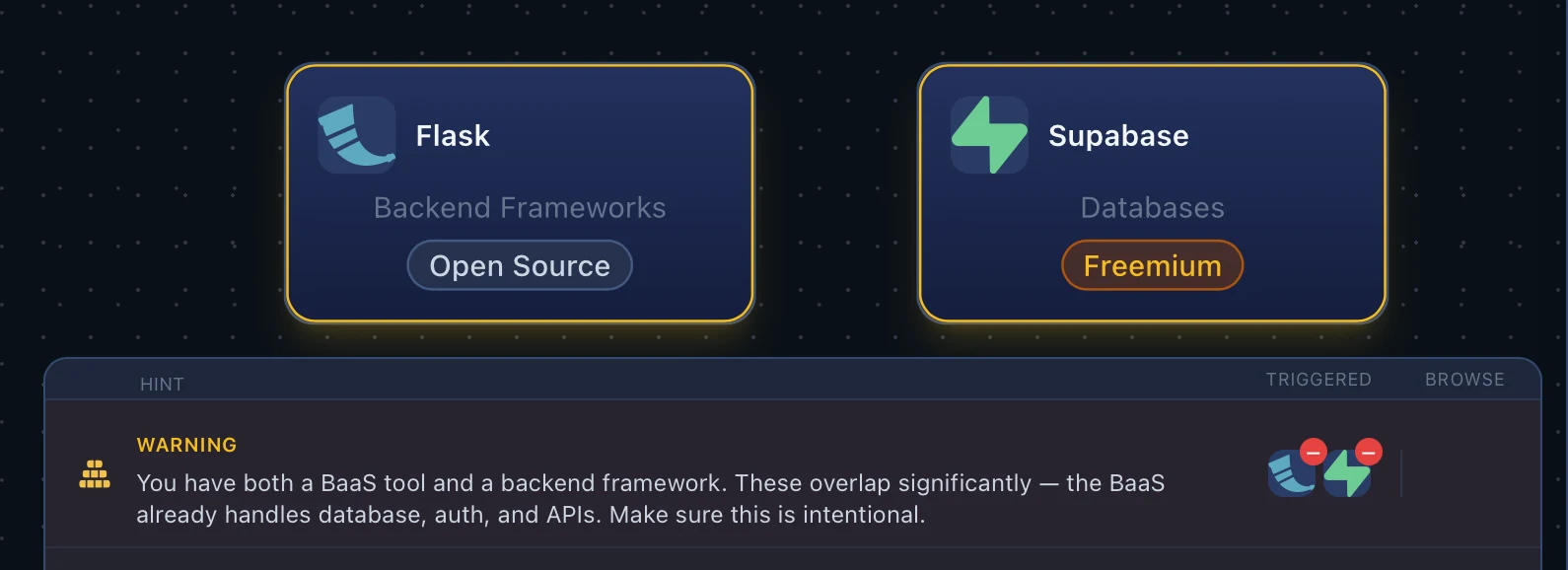
And that hint isn't wrong — it's actually true.
But there's a worthwhile exception: pairing Supabase with a lightweight Python framework like Flask or FastAPI, not because Supabase is too limited, but because the combination is genuinely useful on its own terms. Even if you never touch Supabase's auth system or realtime subscriptions, what's left is still a strong foundation for a side project or small production app.
Supabase is a managed Postgres database
The core of Supabase is PostgreSQL. You get a real Postgres instance — full SQL support, indexes, foreign keys, migrations — managed by Supabase so you don't have to provision or configure a server yourself.
For a Flask or FastAPI project, this means you can treat Supabase the same way you'd treat any Postgres database. Connect with psycopg2, SQLAlchemy, or a raw connection string. Run your own migrations. Write SQL queries. Nothing about the development workflow changes — you just don't have to run the database server yourself.
The free tier goes a long way
Supabase's free tier is generous by the standards of managed databases: 500MB storage, 1GB file storage, and 50,000 monthly active users for auth. For a side project, an internal tool, or an early-stage app, that's typically enough to run without paying anything.
Compared to alternatives — spinning up a managed Postgres on Railway, Render, or Neon — Supabase's free tier is competitive, and it comes with the other features bundled rather than requiring separate services.
The database UI is useful
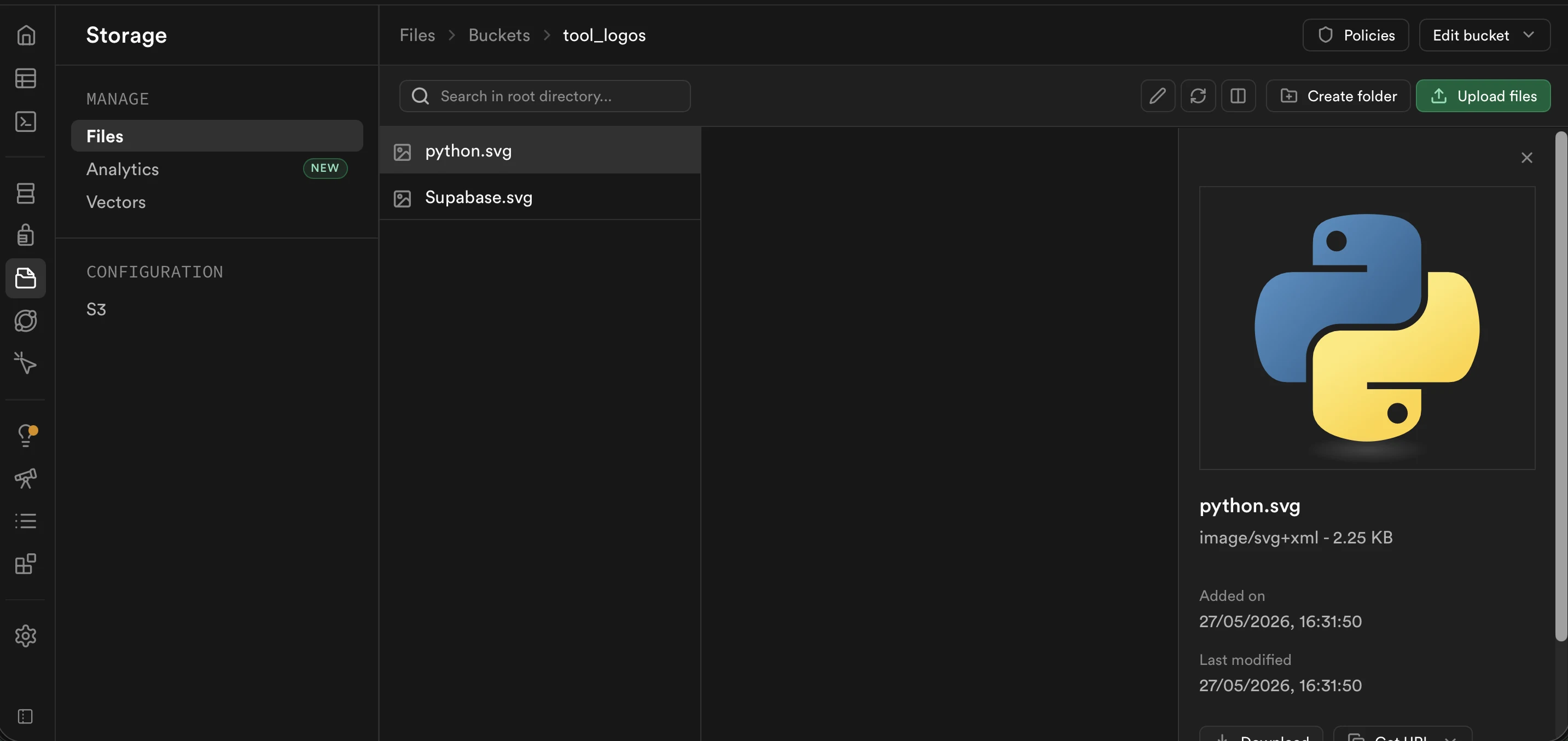
Supabase includes a table editor, SQL editor, and schema browser accessible from the dashboard. For rapid development, this means you can inspect data, run ad-hoc queries, and make quick edits without setting up pgAdmin or a local GUI.
This is the kind of tooling that full-stack frameworks like Django bundle themselves. When you're using a minimal framework that doesn't include a built-in admin interface, Supabase's dashboard fills that gap without any additional setup.
Storage is included
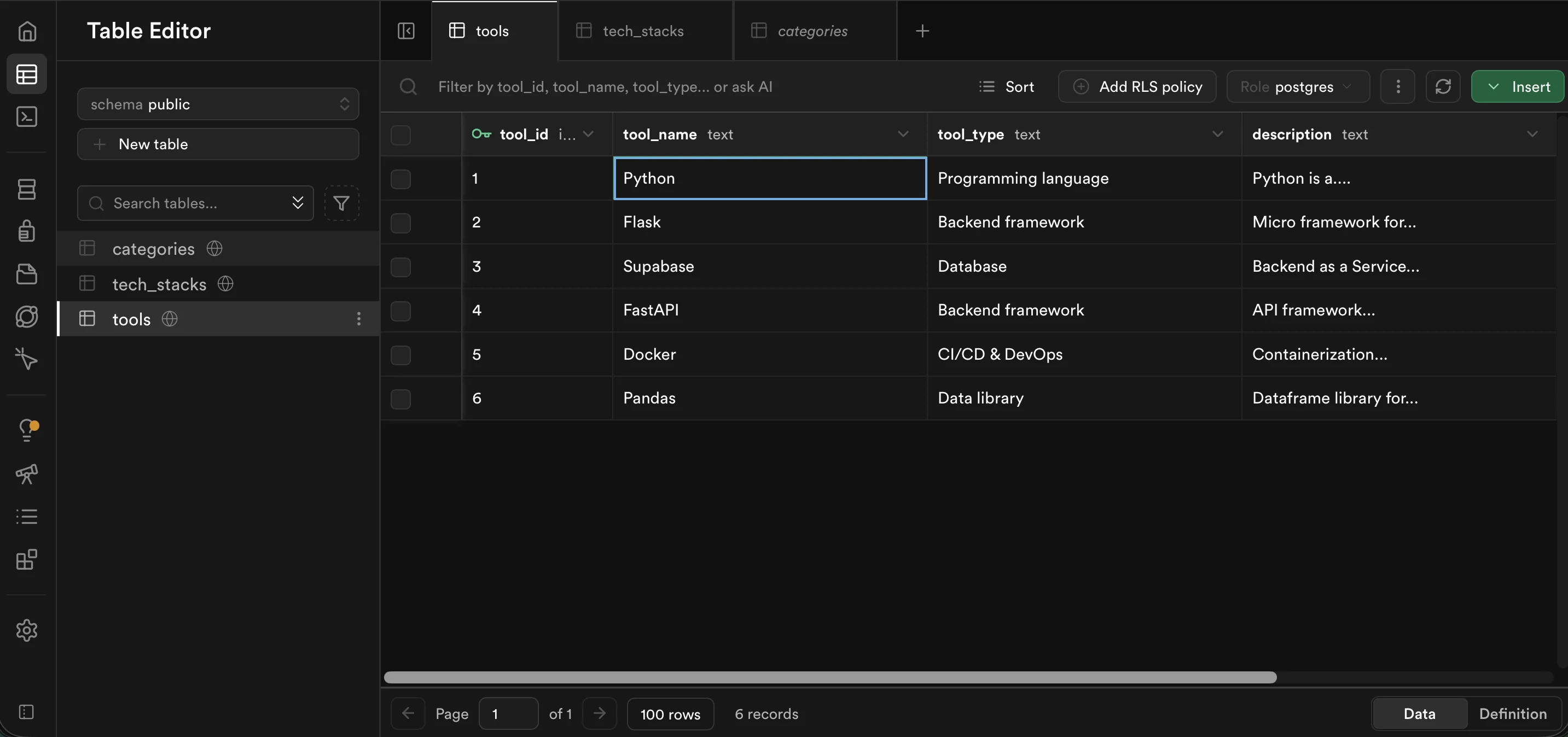
Supabase provides file storage out of the box — S3-compatible buckets with access policies and CDN delivery. For apps that handle image uploads, document storage, or any kind of file management, this removes the need to configure a separate object storage service.
A Flask or FastAPI app can interact with Supabase Storage via the Python client library or directly through its S3-compatible API. The storage is tied to the same project as your database, which keeps credentials and access management in one place.
Which frameworks pair well
The combination works best with minimal frameworks that don't bundle their own database tooling:
Flask is the natural fit. It has no built-in ORM, no admin panel, and no opinions about how you structure your data layer. Supabase fills exactly the gaps Flask leaves: a database, somewhere to store files, and a UI for managing both.
FastAPI follows the same logic. It handles routing, request validation, and dependency injection — and nothing else. Supabase provides the data layer, which FastAPI doesn't include.
The same logic applies to Express.js (Node.js). If you're building a Node backend rather than Python, the reasoning holds: minimal framework plus managed Postgres plus Supabase Storage is a coherent stack for small-to-medium apps.
The pattern generalises: any lightweight framework that routes requests and runs business logic, but doesn't prescribe how you store data, is a good candidate.
Which frameworks don't fit as well
The pairing makes less sense with opinionated, full-featured frameworks:
Django bundles an ORM that manages migrations, an admin panel for browsing and editing database records, and a storage abstraction (via django-storages) for file handling. These features overlap directly with what Supabase provides. The advantages of Supabase's UI and storage become redundant, and maintaining two separate systems for the same job adds friction rather than removing it.
Ruby on Rails is in the same position. ActiveRecord, Rails admin, and Action Storage cover the same ground. The more a framework already handles, the less Supabase adds over a self-managed Postgres instance.
The rule of thumb: if your framework already provides an admin interface, an ORM, and a file storage layer, Supabase's distinctive features won't get much use.
The bottom line
You don't need to use all of Supabase to get value from it. If you're building with Flask or FastAPI and don't have a Postgres instance already running, Supabase gives you a managed database, a usable UI, and file storage in one place — all on a free tier that covers most small apps.
That's a reasonable foundation even without touching Supabase's realtime subscriptions, edge functions, or row-level security. The managed database alone is often worth it.
Related Stacks
Flask + Supabase
ProjectA beginner-friendly Python stack for side projects and small apps. Flask handles routing and server logic; Supabase provides managed PostgreSQL, file storage, and a built-in database UI, without the overhead of self-managing a Postgres server. No separate frontend is needed either: Flask renders the pages through Jinja2 HTML templates.
Base Flask + Supabase tech stack.




Flask + Supabase + HTMX
ProjectA server-rendered Python stack with dynamic interactions and no JavaScript build step. Flask handles routing and Jinja2 templating; HTMX adds partial-page updates; Supabase provides managed PostgreSQL, file storage, and a database UI. Tailwind CSS is an optional styling addition.
Flask + Supabase tech stack, with an addition of HTMX for frontend interactivity.

FastAPI + Supabase
ProjectA lightweight async Python API backed by Supabase's managed Postgres. FastAPI handles business logic and typed endpoints; Supabase provides the database, storage, and auth, which suits APIs that want a managed data layer without operational overhead.
Base FastAPI + Supabase tech stack.