How to Choose a Tech Stack in 2026
AI coding tools changed the game, but the underlying technology decisions are still yours to make. Here's how to navigate the options.
Contents
Back in the day, so basically in "pre-AI" times, hence not so long ago, if you would ask someone what's their tech stack, the answer would most likely be a list of frameworks, programming languages, maybe no-code tools, but in general it would come down to a handful of tools.
Fast forward only 4 years, and the answer more often is:
"My tech stack is Claude Code".
"My tech stack is Codex".
That's quite a different reality, but not necessarily a simpler one.
The agentic tools like Claude Code and Codex are not replacing all the other tools (at least not yet), and the AI builders like Lovable and Replit are still generating code in the exact same frameworks in which code was previously written manually.
So how to choose a tech stack in 2026?
Let's tackle this.
What a tech stack actually is
A tech stack is the set of technologies that make up a software project: the frontend framework, the backend runtime, the database, the infrastructure layer, and everything in between.
This is described in detail in the What is a Tech Stack article, where we also distinguish tech stack types: project tech stack, developer tech stack, and infrastructure tech stack. These types naturally blend together, and they impact each other. Most of the new tools, like AI coding assistants, are part of a developer tech stack, but they fundamentally change how the projects themselves are being created.
AI-assisted coding tools: they work within your stack
AI-assisted coding tools, including the ones based on traditional IDEs — like Cursor or Windsurf — or agentic tools — like Claude Code, Codex or Warp — are tools that help you work inside a stack. They write code, explain errors, suggest refactors, and increasingly manage multi-step tasks in your terminal. They're very good at what they do. Or maybe we should say:
they are as good as you prompt them.
But they work on your stack, not instead of it. Claude Code still runs inside a FastAPI project or a Django project. It generates SQL against your database schema. It writes Dockerfiles for your infrastructure. When someone says "my stack is Claude Code," what they usually mean is that Claude Code handles most of the typing. Underneath that, there's still a real stack with real technology decisions.
This is totally different than using no-code tools like Bubble, established in the industry for many years, where there's an extra abstraction layer. There's of course code underneath, but we don't touch it at all. We interact with the interface, which basically integrates everything for us.
With AI-assisted coding tools, we don't replace programming languages and frameworks with another tool. We rather add tools that work beside them. All the choices (and mistakes) are still here to make.
AI builders: they do choose the stack for you
AI builders — Lovable, Bolt.new, v0, Replit Agent — sit in a different category. These tools generate entire apps from a natural language prompt. You describe what you want, and you get a working prototype.
In theory, with agentic tools we can do the same: you describe what you want, and Claude Code will generate the whole app for you.
But the difference is, the AI builders are one integrated environment. They wire up the database for you, they let you host the app instantly on their server, and you connect your own domain as well.
With AI-assisted coding tools we have to do all of it ourselves. Of course, there are integrations, APIs and MCP servers, but AI builders are doing way more out-of-the-box.
And most of the time (with some exceptions), they will choose the tech stack for us as well, and we might not have an impact at all on selecting the technologies. But predefined choices by the AI builder might actually be mistaken ones for our use case.
Why the choices feel harder than ever
Here's what actually happened in the last few years: AI tools removed the skill barrier to using a wider range of technologies. We can forget about a learning curve. We don't have to care about a tool's market share. We just prompt, and we get the code (or the app).
Building software has never been as accessible as it is now. Whether that's a good or bad thing is not the debate here.
But one thing is certain: even though creating software is more widespread, we haven't eliminated (at least not yet) the need to make decisions about the underlying technologies of the software we're making.
So all the technical debates we were having before, we still have them now:
- Which frontend and backend frameworks should we use? Or do we actually need a backend framework at all?
- What type of database should we go for?
- What about hosting? Cloud or VPS?
- Scaling? Will the app be able to handle increasing workload?
...and the list could go on.
AI might attempt to answer all of this. And it might be very successful. But it's based on us. On the context that we provide, on the guidelines that we set up, and the choices that we make beforehand.
And the list of potential issues has extended as well:
- If we don't select the tech stack beforehand, the AI choice might be far from ideal
- If we use an AI builder with a predefined tech stack without verifying if that's a good choice for our use case, we potentially set ourselves up for a big headache
- We also have to choose the right AI tools for us, and the number of available tools is growing literally every day
So things have been simplified and made more complicated at the same time.
How to think through it
The stack decision still comes down to the same underlying questions, regardless of whether AI is doing the implementation:
What type of project is this? A web app, a data pipeline, a browser extension, a mobile app, and an automation workflow have different natural stacks. The tool ecosystem for each project type doesn't overlap much.
Who is building and maintaining it? A solo developer with a Python background, a team with mixed experience, or a non-technical founder using an AI builder are different starting points with different realistic options. The "best" stack for any project is partly a function of who's operating it.
What are the operational constraints? Self-hosted vs managed, cheap vs scalable, relational vs document, type-safe vs flexible — these are questions with real answers that depend on the specific project, not on general best practice.
How long will it live? A weekend project has different needs than a platform you'll operate for three years. AI builders are the right call for the former; they introduce meaningful technical debt for the latter.
You don't have to be an expert in the framework in which the project will be built. Well, potentially you don't even have to know the syntax at all if AI will do the coding. But you should know how this framework works, and why it's a good fit.
So knowing every line of code in your codebase might no longer be necessary. But understanding and controlling your tech stack is.
Where Tekyous fits in
Tekyous is an interactive tech stack builder designed to make the whole selection process more structured.
In the Builder, you can start from a questionnaire — describe your project type, technical level, and language preferences — and get a curated starting stack with a rationale for each tool and options to swap alternatives. Or open the sandbox and drag tools onto a canvas, where the platform gives you real-time hints on compatibility, missing dependencies, and pairings as you build.
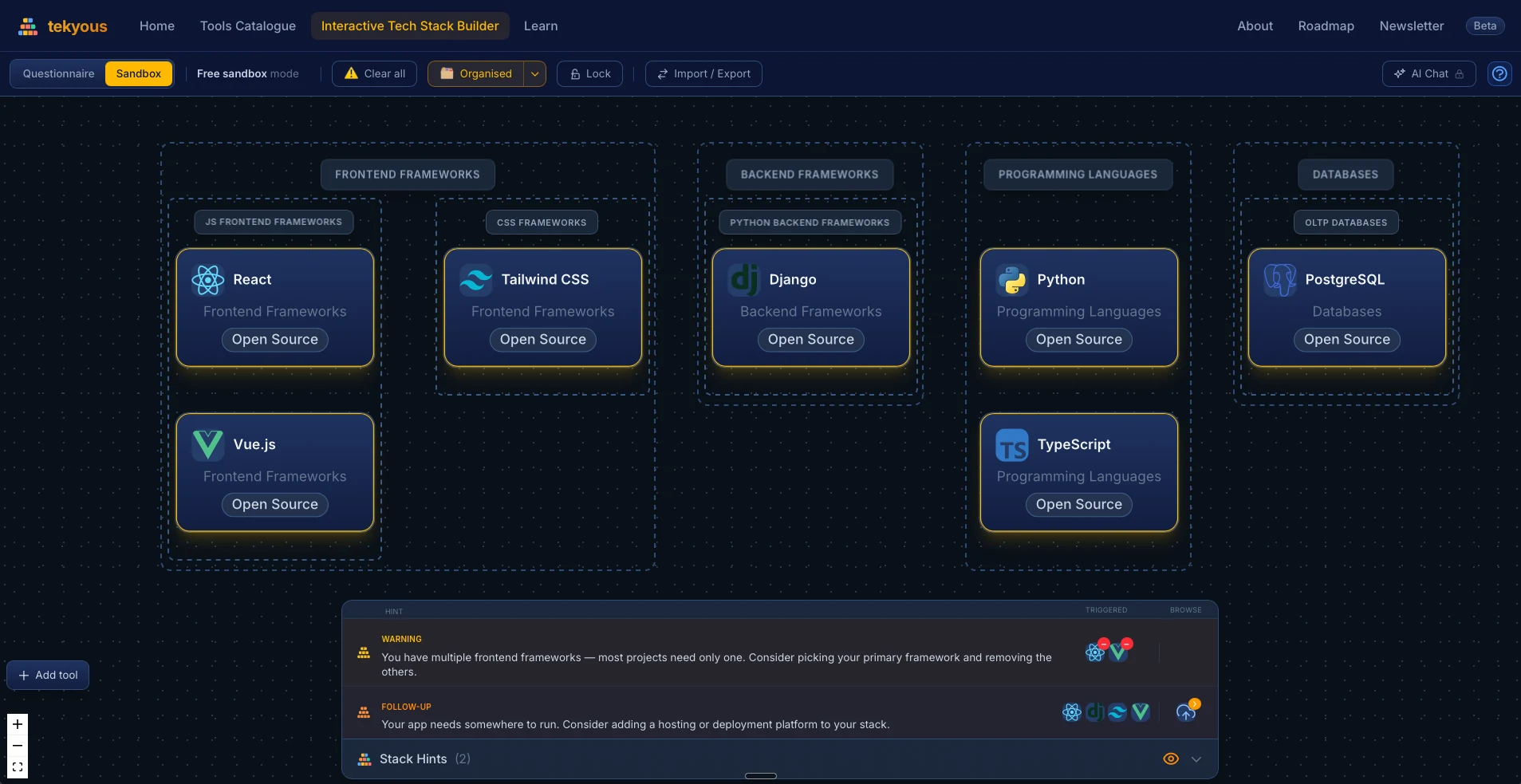
The catalogue covers 150+ tools across web development, data tooling, automation, infrastructure, and AI tooling. Recommendations are rule-based and deterministic: not AI-generated suggestions, but data on how tools actually relate to each other — pairings, conflicts, and dependencies built into the database.
Whether you're using Claude Code to write the implementation, Lovable to prototype it, or writing everything yourself — the underlying technology decisions still matter. Tekyous is the place to work them out before you're committed.